
Orthodontic Blog
Can Invisalign Fix a Crossbite?
Yes, Invisalign can correct crossbites. Whether aligners work alone depends on if the crossbite is dental or skeletal, and severe skeletal cases may need surgery.

- Dr. Boris Pinhasov, DDS
- September 25, 2026
Medically reviewed by Dr. Boris Pinhasov, DDS - Diplomate, American Board of Orthodontics | Last Updated: September 2026
Yes. Invisalign corrects crossbites. What decides your case is whether the crossbite comes from the position of your teeth or the position of your jaws, because a severe jaw discrepancy can need surgery alongside the aligners.
Is Your Crossbite Dental or Skeletal?
This is the distinction that decides almost everything about your treatment, and it is the one most articles skip.
A dental crossbite means the jaws line up reasonably well and individual teeth have tipped or drifted into the wrong position. Aligners are well suited to this. The correction is tooth movement, which is what they were built to do.
A skeletal crossbite means the upper jaw itself is narrow or positioned differently from the lower one. The teeth are only following the bone they sit in, so moving teeth alone can hide the problem without addressing what caused it.
Dr. Pinhasov puts the difficulty plainly: “Skeletal crossbites are more challenging to correct. If the patient is in the growing stage of their life, correction of crossbites is much simpler and requires simpler appliances for correction.”
You will not diagnose this at home, and the difference is not always visible in the mirror. It is what the examination and the X-rays are for.
When Does a Crossbite Need Jaw Surgery?
Rarely, and only at the severe end of the skeletal range.
“Invisalign can definitely fix crossbites. In certain cases orthognathic surgery might be required depending on the severity of the skeletal discrepancy,” says Dr. Pinhasov.
Read the order of that carefully. The default answer is that aligners handle it. Surgery enters the conversation when the gap between the upper and lower jaw is large enough that no amount of tooth movement will produce a stable, healthy bite. In those cases orthodontics and surgical orthodontics work together, with aligners or braces positioning the teeth before and after the procedure.
Severe skeletal discrepancy is the exception rather than the rule, and it is something you should hear about early and clearly rather than after a year of treatment.
Does Your Age Change What Invisalign Can Do?
It changes a great deal, and it works in a child's favour.
While a child is still growing, the upper jaw can still be widened. The bones of the palate have a suture down the middle that has yet to fuse, so a palatal expander can open it gently and create real skeletal change. That is why Dr. Pinhasov describes correction in a growing patient as much simpler, needing simpler appliances.
This is the argument for interceptive orthodontics for growing children, and it is why orthodontists ask to see children around age seven. A crossbite caught while the palate is still expandable can often be addressed with a simpler appliance than the same problem would need later.
Once growth finishes, that window closes. Adults with a skeletal crossbite can still be treated well, and many are treated with aligners alone. The route is simply narrower than it was at nine years old, which is a reason to act now rather than a reason to give up.
Front Teeth or Back Teeth: Does the Location Change Treatment?
A posterior crossbite sits at the back, where upper molars or premolars bite inside the lower ones. It often shows up on one side and can push the lower jaw sideways when you close, which over years can wear teeth unevenly and strain the joint.
An anterior crossbite sits at the front, where one or more upper teeth close behind the lower ones. Patients often describe it as an underbite in one tooth.
Aligners can address both. The plan differs in the mechanics: posterior cases often involve widening the upper arch, while anterior cases usually need space created before a tooth can be walked forward over the bite. Attachments and elastics are common in both, and they are part of ordinary Invisalign treatment rather than a sign of a difficult case.
What Your Orthodontist Needs Before Answering Your Case
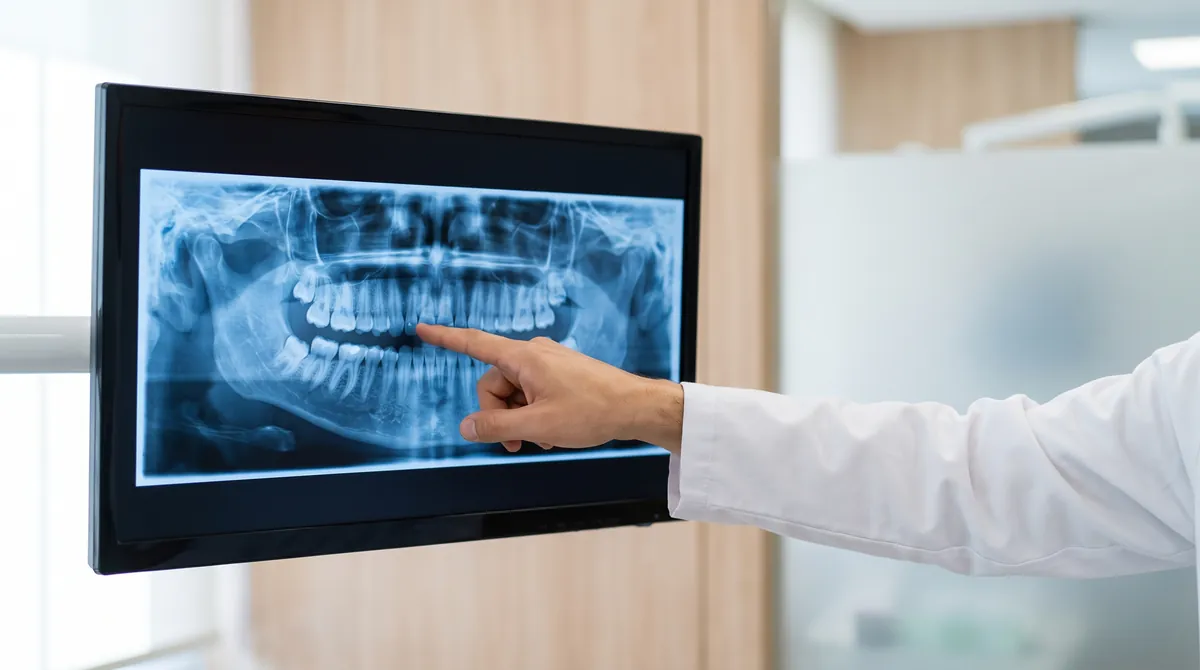
An honest answer about your own crossbite requires records. Dr. Pinhasov describes the standard workup: “Normally, clinical examination combined with panoramic and cephalometric radiographs will guide the orthodontist to determine the best type of treatment for that specific patient.”
The clinical examination shows how your teeth meet and whether your jaw shifts as you close. The panoramic X-ray shows the full set of teeth, roots and jaw joints. The cephalometric X-ray is the side view, and it is the one that measures the relationship between the upper and lower jaw, which is how dental and skeletal cases are told apart.
Anyone promising a treatment plan before seeing those images is guessing. The orthodontic records appointment is where the real answer comes from.
Crossbite Treatment at BP Smiles Orthodontics in Queens
BP Smiles Orthodontics is led by Dr. Boris Pinhasov, DDS, a board-certified orthodontist and a Diplomate of the American Board of Orthodontics, practising at 208-09 Union Turnpike in Oakland Gardens. He treats children, teens and adults, and the office speaks English, Russian and Spanish.
Because the practice offers expanders, braces, Invisalign and coordinated surgical care, the recommendation you receive is based on your records rather than on the one appliance available.
If a crossbite has been mentioned to you, book a free consultation and bring your questions.
Questions Patients Ask About Crossbites and Invisalign
What happens if a crossbite is left alone? Crossbites tend to become more entrenched over time. A bite that shifts to close can wear enamel unevenly, and the asymmetry can become more noticeable as an adult. Treatment is generally more straightforward earlier.
Can Invisalign fix a crossbite in an adult? Often, yes, particularly a dental crossbite. An adult skeletal case may need additional appliances or, at the severe end, a surgical component.
Will I need attachments or elastics? Frequently. Small tooth-coloured attachments give the aligners something to grip, and elastics help correct the bite relationship. Both are routine.
Can Invisalign correct other bite problems at the same time? Usually. Crossbites often travel with crowding or an overbite, and a single treatment plan normally addresses them together.
Disclaimer: This information is provided for educational purposes and is not a substitute for professional medical advice, diagnosis, or treatment. Reading this article does not establish a doctor-patient relationship. Please schedule a consultation with our team to discuss your individual needs.
Ready to Start Your Smile Journey?
Schedule a free consultation with Dr. Boris Pinhasov in Queens.
Keep Reading