
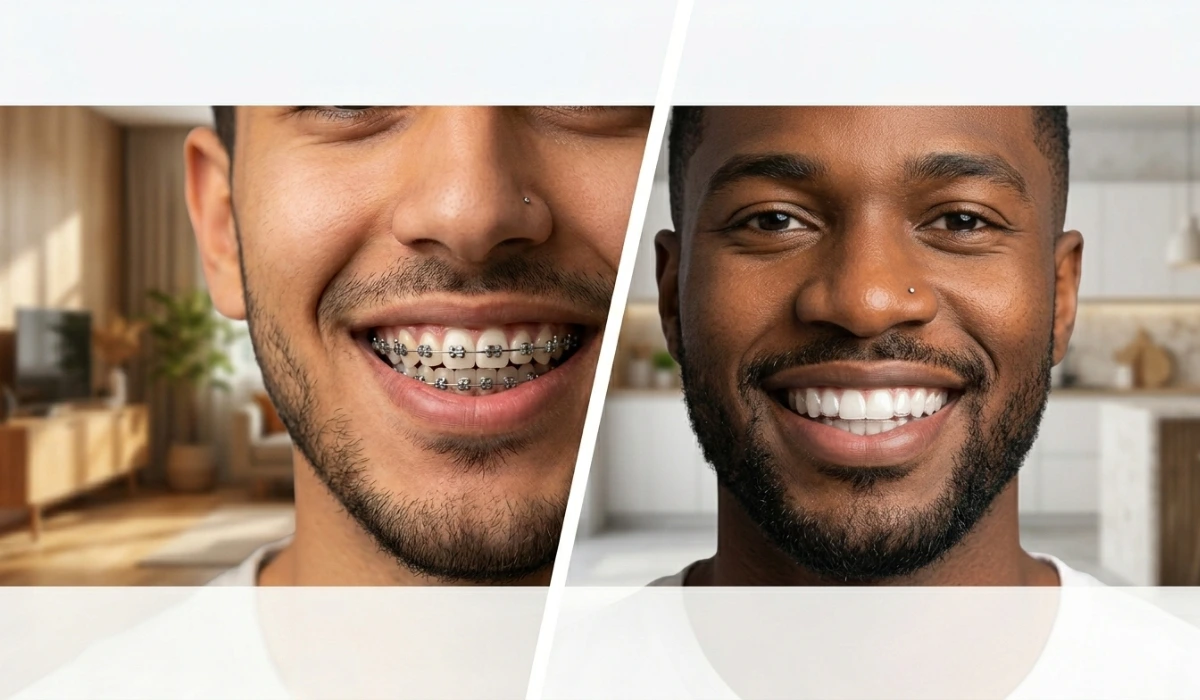
Invisalign is better than braces for patients who want a discreet, removable option and have mild to moderate alignment issues. Braces may be better for complex cases requiring precise tooth control. The best choice depends on your specific orthodontic needs, lifestyle, and personal preferences. Both treatments achieve excellent results when matched to the right patient.
If you are trying to decide between Invisalign and braces, this guide compares the two options honestly so you can make an informed choice.
Invisalign vs Braces: Key Differences
Understanding the fundamental differences between Invisalign and braces helps you evaluate which fits your situation.
- Appearance is the most obvious difference. Invisalign uses clear plastic aligners that are nearly invisible. Most people will not notice you are wearing them unless they look closely. Braces use metal brackets bonded to your teeth connected by wires. Even with tooth-colored ceramic brackets, braces are more visible than clear aligners.
- Removability sets Invisalign apart. You take out your aligners to eat, drink, brush, and floss. Braces stay on your teeth 24 hours a day for the entire treatment duration. You cannot remove them yourself.
- Comfort differs between the two. Invisalign aligners are smooth plastic with no sharp edges. Braces have metal brackets and wires that can irritate your cheeks, lips, and tongue, especially after adjustments.
- Maintenance requirements vary. With Invisalign, you remove aligners and brush your teeth normally. With braces, you must brush and floss around brackets and wires, which takes more time and requires special techniques.
- Office visits happen less frequently with Invisalign. You typically check in every 6 to 8 weeks. Braces require adjustments every 4 to 6 weeks in most cases.
- Treatment time is often similar for comparable cases, typically 12 to 24 months for both. Some studies suggest Invisalign can be faster for mild to moderate cases. Braces may be more efficient for complex corrections.
When Is Invisalign the Better Choice?
Invisalign is often the better choice in specific situations.
- You want nearly invisible treatment. If having visible orthodontic appliances concerns you, Invisalign offers a discreet alternative. Clear aligners let you straighten your teeth without most people noticing.
- Your job or social life makes metal braces inconvenient. Professionals in client-facing roles, public speakers, actors, and others who appear before audiences often prefer Invisalign. The nearly invisible aligners do not affect your appearance during important moments.
- You have mild to moderate crowding, spacing, or bite issues. Invisalign handles these common orthodontic problems very effectively. For straightforward cases, clear aligners deliver excellent results.
- You are disciplined about wearing aligners consistently. Invisalign requires wearing aligners 20 to 22 hours per day. If you will follow instructions and keep aligners in except for eating and brushing, you will get great results.
- You want to eat without restrictions. With Invisalign, you remove aligners to eat. There is no list of forbidden foods. Enjoy popcorn, apples, corn on the cob, and everything else you love.
- You value easier oral hygiene. Brushing and flossing with Invisalign is simple because you take out the aligners first. There are no brackets or wires to navigate around.
When Are Braces the Better Choice?
Braces remain the better option in certain circumstances.
- You have severe crowding or complex tooth rotations. Braces provide more precise control over tooth movement. Severely rotated teeth or complex positioning may respond better to brackets and wires.
- You have significant bite problems. Serious overbites, underbites, crossbites, or open bites sometimes require the level of control that braces offer. Your orthodontist may recommend braces for optimal bite correction.
- You may struggle with aligner compliance. Braces work continuously without requiring your participation. If you know you tend to forget things, lose items, or might not wear aligners consistently, braces remove the compliance factor.
- You are a younger child. Invisalign requires responsibility and discipline. Younger children may not be ready to manage removable aligners properly. Braces ensure treatment progresses regardless of the child’s habits.
- Your orthodontist recommends braces for your case. Sometimes braces simply achieve better results for specific situations. A good orthodontist recommends the treatment that works best, not the one that sounds most appealing.
Is Invisalign Faster Than Braces?
Treatment time depends more on your specific case than on which method you choose.
For comparable cases, Invisalign and braces often take similar amounts of time, typically 12 to 24 months. The severity of your alignment issues and how much your teeth need to move determine the timeline more than the treatment type.
Some research suggests Invisalign can be faster for mild to moderate cases. The computerized treatment planning allows for efficient, precise tooth movements. Patients also avoid delays from broken brackets, which can extend braces treatment.
For complex cases requiring significant bite correction or extensive tooth movement, braces may achieve results more efficiently. The continuous pressure and precise control braces provide can be advantageous for complicated corrections.
Patient compliance also affects speed. An Invisalign patient who wears aligners religiously will likely finish on time. An Invisalign patient who frequently leaves aligners out will take longer. Braces work regardless of patient behavior, which can be an advantage for some people.
Is Invisalign More Expensive Than Braces?
Invisalign and braces often cost about the same, typically ranging from $3,000 to $7,000 depending on your case and location.
In some situations, Invisalign costs slightly more due to the technology and custom manufacturing involved. In other cases, prices are nearly identical. The cost difference, if any, is usually not dramatic enough to be the deciding factor.
Insurance coverage is typically the same for both treatments. If your plan includes orthodontic benefits, the coverage usually applies equally to Invisalign and braces.
When comparing costs, consider the full picture. Invisalign may involve fewer office visits, which means less time away from work or school. Braces may require emergency visits if brackets break. These factors can affect the true cost of treatment.
At BP Smiles Orthodontics, we provide transparent pricing for both options during your consultation so you can make a fully informed decision.
Is Invisalign More Comfortable Than Braces?
Most patients report that Invisalign is more comfortable than traditional braces.
Invisalign aligners are smooth plastic with no sharp edges. There are no metal brackets rubbing against your cheeks and lips. There are no wires poking your gums. The aligners fit snugly over your teeth without irritating soft tissue.
Both treatments involve some discomfort because teeth are being moved. You will feel pressure with Invisalign, especially when switching to new aligners. But this pressure is generally milder and more evenly distributed than the soreness from braces adjustments.
Braces discomfort often comes from the hardware itself. Brackets can irritate the inside of your mouth until you develop calluses. Wires can poke and scratch. Adjustments can cause significant soreness for several days.
If comfort is a priority for you, Invisalign typically offers a gentler experience.
Can Invisalign Do Everything Braces Can?
Invisalign technology has advanced significantly, and clear aligners now treat most common orthodontic issues effectively.
Invisalign successfully corrects crowding, spacing, overbites, underbites, crossbites, and open bites in many patients. For mild to moderate cases, Invisalign achieves results comparable to braces.
However, some limitations remain. Certain severe cases still respond better to braces. Significant tooth rotations, complex bite issues, and cases requiring precise vertical movements may be more predictable with brackets and wires.
An experienced orthodontist knows which tool fits each case. Dr. Boris Pinhasov evaluates every patient individually and recommends the treatment most likely to achieve optimal results.
“Invisalign is a great alternative to traditional braces and does a great job with crowding and spacing,” says Dr. Pinhasov. For patients whose cases fall within Invisalign’s capabilities, clear aligners deliver excellent outcomes.
How to Decide Between Invisalign and Braces
Making the right choice requires considering several factors.
- Evaluate your orthodontic needs. What issues need correction? Mild crowding may be perfect for Invisalign. Severe bite problems may favor braces. Your orthodontist’s assessment is essential.
- Consider your lifestyle. How important is appearance during treatment? Do you have the discipline to wear aligners consistently? Do you frequently snack throughout the day? These factors affect which option fits better.
- Think about your daily routine. Can you commit to removing aligners for every meal and snack? Will you remember to put them back in? Are you comfortable with the extra brushing Invisalign requires?
- Discuss with your orthodontist. A professional evaluation reveals which treatment will work best for your specific case. Your orthodontist sees factors you cannot assess yourself.
- Trust the recommendation. If your orthodontist says braces will achieve significantly better results, consider that advice seriously. The goal is a great outcome, not a specific treatment method.
Invisalign and Braces at BP Smiles Orthodontics
At BP Smiles Orthodontics in Queens, we offer both Invisalign and traditional braces because different patients need different solutions.
Dr. Boris Pinhasov is an ABO board-certified orthodontist with over 20 years of experience. Board certification is achieved by fewer than one in three orthodontists, demonstrating commitment to the highest standards of care. Dr. Pinhasov is both a certified Invisalign provider and highly experienced with braces.
During your free consultation, we evaluate your teeth, bite, and orthodontic needhttps://bpsmilesny.com/contact/s using our Lumina Itero 3D scanner. We explain which treatment options can achieve your goals and recommend the approach most likely to deliver excellent results.
We give honest recommendations. If Invisalign and braces would both work well for your case, we explain the tradeoffs so you can choose based on your preferences. If one option is clearly better for your situation, we tell you directly.
With over 170 five-star Google reviews and a 5.0 rating, BP Smiles has earned the trust of families throughout Queens, Flushing, and Bayside. Patients appreciate our transparent guidance and beautiful results.
Schedule your free consultation today to find out whether Invisalign or braces is better for your smile.
FAQs About Invisalign vs Braces
Can I switch from braces to Invisalign during treatment?
In some cases, yes. If your treatment has progressed to a point where Invisalign can complete the remaining corrections, switching may be possible. Discuss this with your orthodontist if you are interested.
Do braces work faster than Invisalign for overbite?
It depends on the severity of the overbite. Mild to moderate overbites often respond equally well to both treatments. Severe overbites may be corrected more efficiently with braces in some cases. Your orthodontist can advise based on your specific bite.
Is Invisalign worth it over braces?
For patients who value discreet appearance and removable aligners, Invisalign is often worth choosing. For complex cases or patients who prefer not to manage removable appliances, braces may be the better value. Both deliver great results when matched to appropriate cases.
Which is better for teenagers, Invisalign or braces?
Both work well for teens. Invisalign Teen is designed specifically for adolescent patients and includes compliance indicators. However, teens who may not wear aligners consistently might do better with braces. Maturity and responsibility level matter.
Can I get Invisalign if my orthodontist recommended braces?
You can ask about Invisalign, but if your orthodontist specifically recommends braces, there is likely a clinical reason. Discuss your concerns openly. A good orthodontist explains why one option is better for your case and helps you understand the recommendation.
Disclaimer
Medically reviewed by Dr. Boris Pinhasov, Board-Certified Orthodontist.
This content is for educational purposes only and is not intended as medical advice, diagnosis, or treatment. Please consult a qualified healthcare provider for personalized recommendations.
