
Medically reviewed by Dr. Boris Pinhasov, DDS – American Board of Orthodontics Diplomate | 20+ Years Experience | Last Updated: March 2026
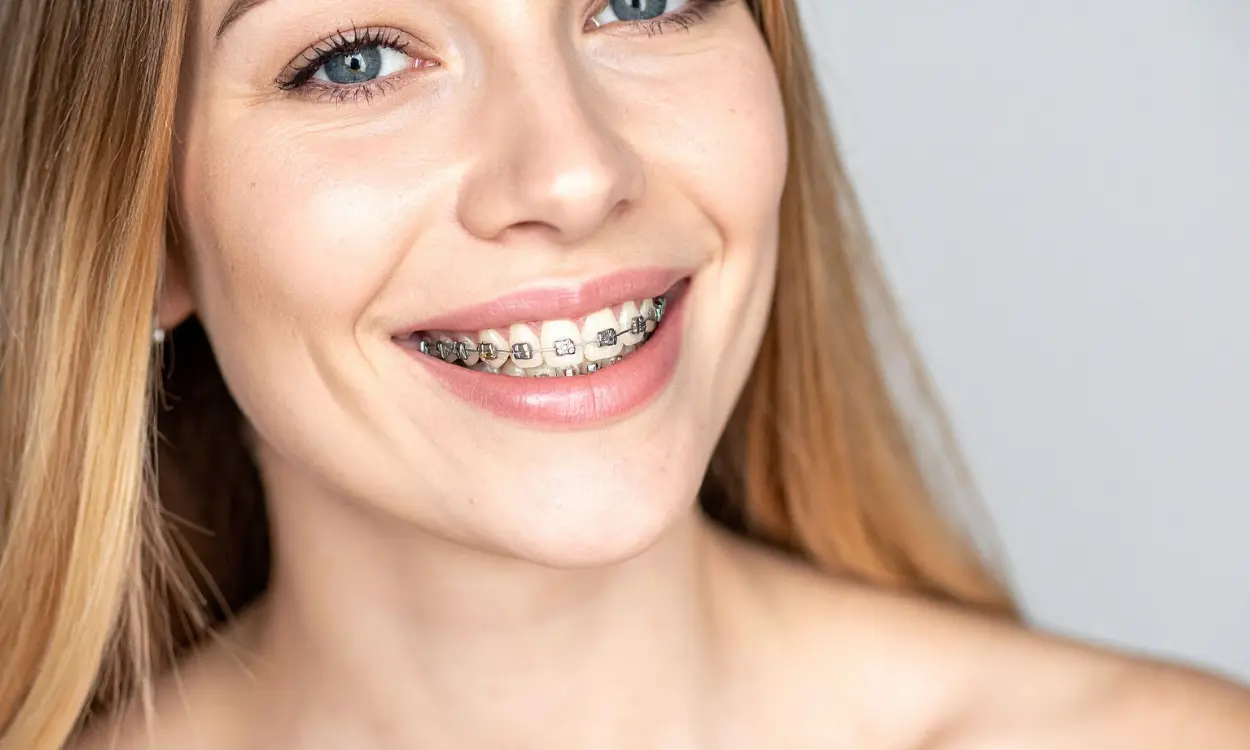
Braces work by applying constant, gentle pressure to your teeth over time. This pressure slowly moves teeth into proper alignment by remodeling the bone around them. Brackets bonded to each tooth are connected by an archwire that guides teeth into their correct positions over 12 to 24 months.
Understanding how braces work can help you feel more confident about your orthodontic treatment. Whether you are considering braces for yourself or your child, this guide explains the science behind tooth movement and what happens at each stage of treatment.
The Science Behind How Braces Move Teeth
Braces do not simply push teeth into new positions. They trigger a biological process called bone remodeling that allows teeth to move safely through the jawbone.
When pressure is applied to a tooth, the bone on one side of the tooth breaks down while new bone forms on the other side. This process involves specialized cells called osteoclasts (which break down bone) and osteoblasts (which build new bone). The constant pressure from braces activates these cells and keeps them working throughout treatment.
The periodontal ligament, a thin layer of tissue that connects each tooth to the surrounding bone, plays a key role in this process. When braces apply pressure, the ligament compresses on one side and stretches on the other. This signals the body to remodel the bone and allows the tooth to shift.
This is why orthodontic treatment takes time. The bone remodeling process cannot be rushed without risking damage to teeth or roots. Your orthodontist carefully controls the amount of pressure applied to move teeth safely and effectively.
Parts of Braces and What Each One Does
Understanding the components of braces helps you see how they work together to straighten your teeth.
Brackets are the small squares bonded directly to the front of each tooth (or the back, in the case of lingual braces). Brackets serve as handles that hold the archwire in place. They are typically made of metal or ceramic and are precisely positioned to control the direction each tooth moves.
Archwire is the thin metal wire that runs through all the brackets and provides the force that moves teeth. The wire is shaped in an ideal arch form, and as your teeth gradually conform to this shape, they straighten. Your orthodontist changes to progressively stronger wires throughout treatment.
Ligatures are the small rubber bands or thin wires that hold the archwire to each bracket. Colored rubber ligatures are what allow patients to customize their braces with different colors. Some braces use self-ligating brackets that do not require ligatures.
Bands are metal rings that wrap around the back molars. They provide a strong anchor point for the archwire and other orthodontic appliances.
Elastics (rubber bands) connect the upper and lower arches to correct bite problems. They apply additional force to move the jaw into proper alignment. Patients wear these between hooks on the upper and lower braces.
Springs and coils are sometimes placed on the archwire to push teeth apart or close gaps.
All these components work together as a system. The brackets position each tooth, the archwire provides the moving force, and the ligatures and elastics fine-tune the pressure and direction of movement.
What Happens When You First Get Braces?
The appointment to get braces placed typically takes one to two hours. Knowing what to expect can help reduce any anxiety about the process.
Step 1: Cleaning and preparation. Your orthodontist starts by thoroughly cleaning and drying your teeth. Clean tooth surfaces allow the brackets to bond properly.
Step 2: Apply the bonding material. A special conditioning gel is applied to the tooth surface, then rinsed off. This creates a slightly rough surface for better bracket adhesion. A bonding adhesive is then applied to each tooth.
Step 3: Placing brackets. Each bracket is carefully positioned on the tooth and pressed into the adhesive. The orthodontist uses a special light to cure (harden) the adhesive. Bracket placement is precise because the position determines how each tooth will move.
Step 4: Attaching the archwire. Once all brackets are in place, the archwire is threaded through each bracket. Ligatures (small rubber bands or wires) secure the wire to the brackets.
Step 5: Final adjustments. The orthodontist checks your bite and makes any necessary adjustments. You will receive instructions on caring for your braces.
You will not feel pain during this appointment. The process involves no needles, no drilling, and no anesthesia. Some patients feel mild pressure as the wire is placed, but the actual bonding process is painless.
What Happens at Adjustment Appointments?
Regular adjustment appointments are essential for keeping your treatment on track. At BP Smiles, most patients visit every 4 to 6 weeks for adjustments.
During an adjustment appointment: Your orthodontist removes the ligatures and archwire. They examine your teeth and check treatment progress. A new or tighter archwire is placed to continue moving teeth. New ligatures are attached to secure the wire. Rubber bands may be added or changed if bite correction is needed. The orthodontist addresses any concerns or issues.
Why adjustments are necessary: As your teeth move, the pressure from the current wire decreases. Changing to a new wire or tightening the existing wire applies fresh pressure to continue movement. Without regular adjustments, teeth would stop moving, and treatment would stall.
How adjustments feel: The appointment itself is quick and painless, usually lasting 15 to 30 minutes. You may feel some soreness for 1 to 3 days afterward as your teeth respond to the new pressure. This is a normal sign that the braces are working.
How Do Rubber Bands Work With Braces?
Rubber bands, also called elastics, are an important tool for correcting bite problems that braces alone cannot fix.
While the archwire moves teeth within each arch, rubber bands connect the upper and lower arches to move the jaw itself. They apply force that shifts how your upper and lower teeth fit together.
Common rubber band configurations: Class II elastics connect upper front teeth to lower back teeth, helping to correct an overbite by pulling the lower jaw forward. Class III elastics connect lower front teeth to upper back teeth, helping to correct an underbite by pulling the upper jaw forward. Vertical elastics connect upper and lower teeth on the same side to help close an open bite.
Why compliance matters: Rubber bands only work when you wear them as directed, typically 20 to 22 hours per day. Wearing them part-time produces part-time results. Many patients find that inconsistent rubber band wear is the biggest factor in extending treatment time.
Your orthodontist will show you exactly how to place and wear your elastics. At first, it may feel awkward, but most patients quickly get used to the routine.
How Long Does It Take for Braces to Start Working?
Teeth begin moving within days of getting braces, though visible changes take longer to notice.
First few days: Teeth start responding to pressure immediately. You may not see any difference yet, but the bone remodeling process has begun.
First few weeks: Teeth that were rotated or tilted may start showing slight improvement. Most patients do not notice dramatic changes yet.
First 2 to 3 months: Visible changes become noticeable. Gaps may start closing, and crooked teeth begin straightening. This is when many patients first see that braces are working.
6 months and beyond: Significant improvement is usually visible. Major crowding and spacing issues show clear progress. The focus shifts to fine-tuning alignment and correcting bites.
Full treatment: Most patients wear braces for 12 to 24 months. Dr. Boris Pinhasov notes that treatment “usually takes anywhere from 12 to 36 months depending on many factors, including the age of the patient, growth pattern, surgical necessity, and more.”
Every patient responds differently to treatment. Some see rapid early progress, while others take longer to show visible results. Trust the process and follow your orthodontist’s instructions for the best outcome.
What Happens After Braces Come Off?
Getting braces removed is an exciting milestone, but it is not the end of your orthodontic journey. The retention phase that follows is critical for maintaining your results.
Braces removal: Your orthodontist uses a special tool to gently pop each bracket off your teeth. The adhesive is then polished away. The process is quick and painless, typically taking less than an hour.
Why retainers are necessary: After braces come off, your teeth have a natural tendency to shift back toward their original positions. This is called relapse. The bone around your teeth needs time to fully solidify in the new positions. Retainers hold teeth in place while this stabilization occurs.
Types of retainers: Removable retainers are worn at night and can be taken out for eating and cleaning. Fixed retainers are thin wires bonded to the back of your front teeth, holding them permanently in place. Some patients use a combination of both.
How long you wear retainers: Most orthodontists recommend wearing removable retainers full-time for the first few months, then transitioning to nighttime wear. Many patients wear retainers at night indefinitely to prevent any shifting.
The retention phase is just as important as the active treatment phase. Without proper retainer wear, teeth can shift and undo the progress achieved with braces.
How Dr. Boris Customizes Your Braces Treatment
At BP Smiles Orthodontics, every treatment plan is personalized to achieve the best results for each patient.
Dr. Boris Pinhasov uses digital 3D scanning technology to create precise images of your teeth and jaw. This eliminates the need for uncomfortable traditional impressions and allows for detailed treatment planning. Modern, low-profile brackets are more comfortable and effective than older designs.
“Everyone deserves our best, all the time,” says Dr. Boris Pinhasov. “We create customized treatment plans designed to achieve beautiful results as efficiently as possible.”
Dr. Boris is a board-certified orthodontist and a Diplomate of the American Board of Orthodontics with 20 years of experience. As the Director of the Orthodontic Program at Maimonides Medical Center, he stays at the forefront of orthodontic techniques and technology.
BP Smiles has earned over 170 five-star Google reviews from families throughout Queens. Patients appreciate the clear explanations, efficient appointments, and outstanding results.
Located at 208-09 Union Turnpike in Flushing, BP Smiles offers free consultations where Dr. Boris will explain exactly how braces can work for your smile. Evening and Sunday appointments are available to fit your schedule.
Frequently Asked Questions
Do braces work the same for everyone?
The principles are the same, but treatment details vary based on each patient’s needs. The severity of misalignment, bite issues, age, and compliance all affect how quickly and effectively braces work for each individual.
Can braces fix all teeth problems?
Braces can correct most alignment and bite issues, including crowding, spacing, overbites, underbites, crossbites, and open bites. Some severe jaw problems may require surgical orthodontics in addition to braces.
Do braces weaken teeth?
No, properly applied braces do not weaken teeth. The bone remodeling process is natural and safe when controlled by a trained orthodontist. Teeth remain healthy and strong throughout treatment.
How do self-ligating braces work differently?
Self-ligating braces use special brackets with built-in clips instead of rubber ligatures to hold the archwire. This may reduce friction and can sometimes result in shorter appointments. The fundamental tooth movement process is the same as traditional braces.
How do clear aligners work compared to braces?
Clear aligners like Invisalign also use pressure to move teeth, but the force comes from custom-molded plastic trays instead of brackets and wires. Aligners are changed every one to two weeks to progressively shift teeth. Both methods rely on the same bone remodeling process.
Disclaimer
Medically reviewed by Dr. Boris Pinhasov, Board-Certified Orthodontist.
This content is for educational purposes only and is not intended as medical advice, diagnosis, or treatment. Please consult a qualified healthcare provider for personalized recommendations.
